

Illinois Tax Reform Backed by Voters Could Cut Property Taxes 20% or Fully Fund Schools

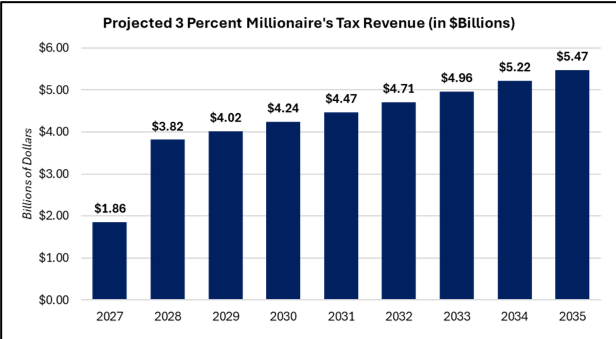
Projected 3 Percent Millionaire's Tax Revenue
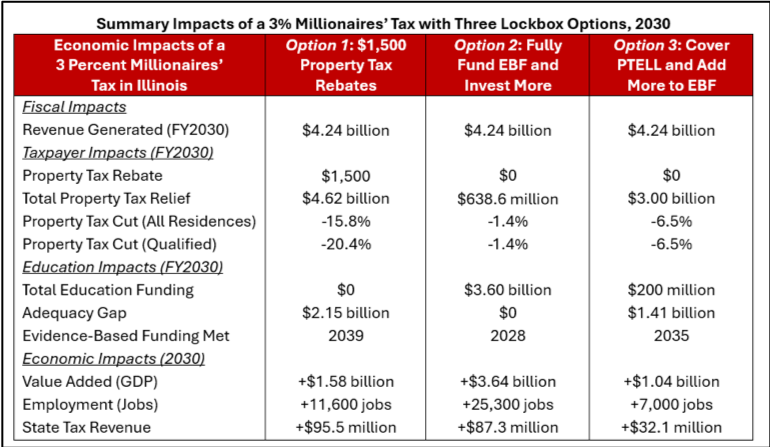
Summary Impacts of a 3% Millionaires' Tax with Three Lockbox Options, 2030

Project for Middle Class Renewal
Read Adopting a Millionaires’ Tax in Illinois: Impacts on Property Taxes, Public Schools, and the Economy.
Utilizing tax data from the Illinois Department of Revenue, local school funding and property tax data, and industry-standard IMPLAN analysis, the study estimates the broad-based effects of a potential “millionaires’ tax” in Illinois, which would require a constitutional amendment approved by the voters. In 2023, less than one-half of 1% of all tax filers in the state earned net incomes in excess of $1 million.
“Illinois has one the nation’s most regressive state and local tax systems and one of the highest rates of local property taxes, which provide the disproportionate share of funding for pre-K through 12 public schools,” said ILEPI Economist and study coauthor Frank Manzo IV. “This new study shows that a 3% surtax on income over $1 million would raise billions of dollars annually to improve school funding, alleviate property tax burdens, or both—while delivering a boost to the state’s economy in the bargain.”
Researchers note that Illinois’ tax system, which includes a flat income tax, property taxes, and a range of sales taxes and user fees, ranks amongst the most regressive in the nation, requiring working and middle-income families to pay significantly higher shares of their incomes toward taxes than wealthier households. Data shows Illinois’ richest 1% of households saw their incomes grow more than twice as fast as the bottom 99% between 1985 and 2025. Four other states and the District of Columbia have already adopted surtaxes on incomes above $1 million, and their economies have grown just as fast as states without the policy. Today, Illinois’ million-dollar income earners pay as much as 6% lessin taxes than they would in states that have adopted millionaires’ taxes.
“The data shows that millionaires’ taxes do not make states less economically competitive, but can make them more affordable for working and middle-class families,” said study coauthor, professor, and PMCR Director Dr. Robert Bruno. “They come at a nominal cost to one-half of 1% of the state’s wealthiest tax filers, but could provide real relief to 3 million homeowners and 2 million students across Illinois.”
Researchers modeled the economic and fiscal impacts of three different “millionaires’ tax” options that Illinois could adopt, each based on advisory referenda passed by voters and including “lockbox” provisions that would direct and protect how proceeds could be used. One scenario would earmark revenue for property tax rebates, a second would fully fund Illinois’ public schools, and a third would cover property tax levy increases for all school districts across the state.
In the direct property tax relief scenario, researchers found that a 3% surtax on net incomes exceeding $1 million would deliver annual property tax rebates ranging from $1,200 in 2027 to $1,800 by 2034 to every homeowner with a general homestead exemption—or an average property tax cut of 20% for 3 million homeowners. The largest beneficiaries would be low-income and middle-income filers. Researchers projected that the relief would improve Illinois’ competitiveness nationally.
The school funding scenarios would enable the State to fully fund its Evidence-Based Funding model either immediately or at a faster pace. The Evidence-Based Funding model has already put hundreds of the most under-resourced school districts on sound financial footing, reduced class sizes, and improved graduation rates. The model currently faces a funding gap of $3 billion, but adoption of a millionaires’ tax would close this gap and enable local school districts to stem the growth of property tax levies, which currently account for the majority of pre-K through 12 school funding in Illinois.
The “hybrid” option would freeze school property tax levies for the next 8 years while devoting $50 million more per year to supporting the Evidence-Based Funding model.
Industry-standard IMPLAN analysis revealed that all models would generate positive returns, creating between 7,000 and 25,000 jobs and boosting Illinois’ gross domestic product (GDP) by between $1 billion and $4 billion. These net effects occur because the tax reform would put more money in the pockets of working and middle-class taxpayers most likely to spend it back in the local economy or make investments in public education that generate long-term economic value.
“Representing the expressed will of voters to tax individuals with incomes over $1 million and protecting proceeds in a lockbox could be a win for middle-class homeowners, a win for students, and a win for Illinois’ economy,” Manzo concluded. “Just as the millionaires’ tax has not adversely affected other states, the data shows that it would deliver meaningful tax relief for millions of working families, a more stable financial future for local school districts, and greater economic activity across Illinois.”
The Illinois Economic Policy Institute (ILEPI) is a nonprofit, nonpartisan research organization founded in 2013 to deliver actionable research and expert analysis on public policy issues impacting
The Project for Middle Class Renewal (PMCR) at the University of Illinois at Urbana-Champaign investigates working conditions in today's economy to elevate public discourse aimed at reducing poverty, create more stable forms of employment, and promote middle-class jobs.
X: https://twitter.com/pmcr_illinois
Instagram: https://www.linkedin.com/company/pmcr-illinois/
Todd Stenhouse
The Illinois Economic Policy Institute (ILEPI)
916-397-1131
toddstenhouse@gmail.com
Visit us on social media:
LinkedIn
Instagram
Facebook
X
Legal Disclaimer:
EIN Presswire provides this news content "as is" without warranty of any kind. We do not accept any responsibility or liability for the accuracy, content, images, videos, licenses, completeness, legality, or reliability of the information contained in this article. If you have any complaints or copyright issues related to this article, kindly contact the author above.
